Search by VIN, make, model, vehicle type, unit name, or by article number of any oil:

Oil for Hyundai - Lafesta, SQ - EV 56.5kWh 2WD (EM13) (184 hp)
Hyundai Lafesta, SQ EV 56.5kWh 2WD (EM13) (184 hp), year of issue from 2020 date to 2022 - Engine oil, automatic transmission, transmission oil, antifreeze, brake fluid, power steering fluid (power steering) and other fluids.
Fuel: Electric
car drive: Front-wheel drive
Nodes and assemblies
Differential reducer unit
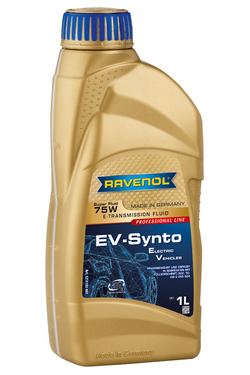
EV-Synto Super Fluid 75W E-TF
RAVENOL EV-Synto Super Fluid 75W E-TF is a synthetic oil that has been specially developed for the requirements of modern electric vehicles. Selected additives ensure good electrical resistance and dielectric properties. The special formulation reduces the energy requirement and at the same time protects the electrical components in the drive train.
Compliance with the requirements:
VW G 055 524
Equivalents OEM:
VAG G052527A2, VAG G052527A2
- Available packaging
- Product parameters
RAVENOL EV-Synto Super Fluid 75W E-TF minimizes friction and wear and thus ensures a long service life of the vehicle. It lubricates and cools the various components of electric vehicles.
Application Note
RAVENOL EV-Synto Super Fluid 75W E-TF is ideally suited for year-round use in all modern electric vehicles. The special additives meet the requirements of many OEMs.
Developed for: Reduction gearboxes in dry and wet engine systems from: MB (EQ-Line), BMW (i-Line), VW (ID-Line), Porsche, Seat, Cupra, Audi, Skoda, Rolls-Royce, Ford, BYD, Renault, Smart, Tata, Jaguar, Citroën
(Manufacturer's instructions must be followed)
First flush the transmission with RAVENOL EV-Synto Super Fluid 75W E-TF and then fill it with fresh oil. Follow the manufacturer's instructions!
Characteristics
- Dielectric properties
- Good electrical resistance
- High wear protection
- Excellent material compatibility
- Very good corrosion protection
- Long service life due to high oxidation stability
| Parameter | Unit | Value | Audit | |
|---|---|---|---|---|
| Type | Synthetic |
Synthetic
|
||
| Recomendations | VW G 055 524 |
VW G 055 524
|
||
| Density at 20 °C | g/cm³ | 837.6 | EN ISO 12185 |
837.6
g/cm³
EN ISO 12185
|
| Color | Yellow | visual |
Yellow
visual
|
|
| Viscosity at 100 °C | mm²/s | 7.3 | DIN 51562-1 |
7.3
mm²/s
DIN 51562-1
|
| Viscosity at 40 °C | mm²/s | 34.3 | DIN 51562-1 |
34.3
mm²/s
DIN 51562-1
|
| Viscosity Index VI | 185 | DIN ISO 2909 |
185
DIN ISO 2909
|
|
| Pourpoint | °C | -48 | DIN ISO 3016 |
-48
°C
DIN ISO 3016
|
| Flashpoint | °C | 218 | DIN EN ISO 2592 |
218
°C
DIN EN ISO 2592
|
| Approvals | VW G 055 524 |
VW G 055 524
|
||
| Thermal conductivity at 0 °C | mW/m∙K | 151.9 | ASTM D7896 |
151.9
mW/m∙K
ASTM D7896
|
| Thermal conductivity at 60 °C | mW/m∙K | 146.7 | ASTM D7896 |
146.7
mW/m∙K
ASTM D7896
|
| Thermal conductivity at 60 °C | mW/m∙K | 140.6 | ASTM D7896 |
140.6
mW/m∙K
ASTM D7896
|
| Thermal conductivity at 100 °C | mW/m∙K | 135.1 | ASTM D7896 |
135.1
mW/m∙K
ASTM D7896
|
| Thermal conductivity at 140 °C | mW/m∙K | 130.4 | ASTM D7896 |
130.4
mW/m∙K
ASTM D7896
|
| Specific conductivity at 0 °C | nS/m | 1.13 | DIN EN 60247 |
1.13
nS/m
DIN EN 60247
|
| Specific conductivity at 20 °C | nS/m | 4 | DIN EN 60247 |
4
nS/m
DIN EN 60247
|
| Specific conductivity at 80 °C | nS/m | 56.55 | DIN EN 60247 |
56.55
nS/m
DIN EN 60247
|
| Specific conductivity at 140 °C | nS/m | 208 | DIN EN 60247 |
208
nS/m
DIN EN 60247
|
| Specific heat capacity at 0 °C | J/g∙K | 1.97 | ASTM D7896 |
1.97
J/g∙K
ASTM D7896
|
| Specific heat capacity at 20 °C | J/g∙K | 2.01 | ASTM D7896 |
2.01
J/g∙K
ASTM D7896
|
| Specific heat capacity at 60 °C | J/g∙K | 2.14 | ASTM D7896 |
2.14
J/g∙K
ASTM D7896
|
| Specific heat capacity at 100 °C | J/g∙K | 2.31 | ASTM D7896 |
2.31
J/g∙K
ASTM D7896
|
| Specific heat capacity at 140 °C | J/g∙K | 2.51 | ASTM D7896 |
2.51
J/g∙K
ASTM D7896
|
| Breakdown voltage | kV | 68,7 | IEC 60156 |
68,7
kV
IEC 60156
|
| Low Temp. Pumping viscosity (MRV) at -40 °C | mPa*s | 9.200 | ASTM D2983 |
9.200
mPa*s
ASTM D2983
|
| Recommendations | VW G 055 524 |
VW G 055 524
|
Hydraulic brake system
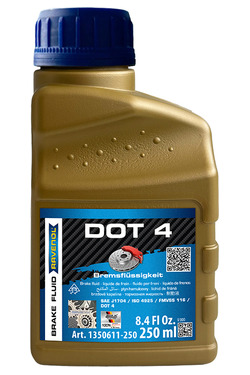
DOT 4
- Available packaging
- Product parameters
| Parameter | Unit | Value | Audit |
|---|